A no-nonsense guide for construction managers and procurement teams
They operate on active construction sites — not just in kitchens
There's a big difference between a catering company and a construction site catering company. Most food businesses aren't equipped for restricted access zones, staggered shift breaks, or the chaos of a working Tier 1 site. Ask them directly: how many active construction sites are they currently servicing? If the answer is vague, that's your answer.
A specialist operator will have inductions completed, site protocols understood, and staff who know not to hold up a forklift bay during the morning rush.
Replace with: on-site canteen setup or crew being served at a construction site
"How do you handle site inductions and access restrictions across multiple projects simultaneously?"
Zero cost and zero effort to your project
Your job is to run the build — not manage a food operation. The right caterer takes full ownership: equipment, setup, staffing, restocking, and compliance. You should not be solving their operational problems.
Watch out for any arrangement where the builder is expected to supply infrastructure, coordinate deliveries, or chase invoices for variable costs week to week. A quality operator works on fixed, transparent terms — and absorbs the logistics entirely.
Dietary compliance isn't optional on large crews
With crews of 50 to 500+, you'll have halal requirements, vegetarians, workers managing diabetes, and blokes with serious allergies. A caterer who can't handle dietary variety at volume is a liability — not a partner.
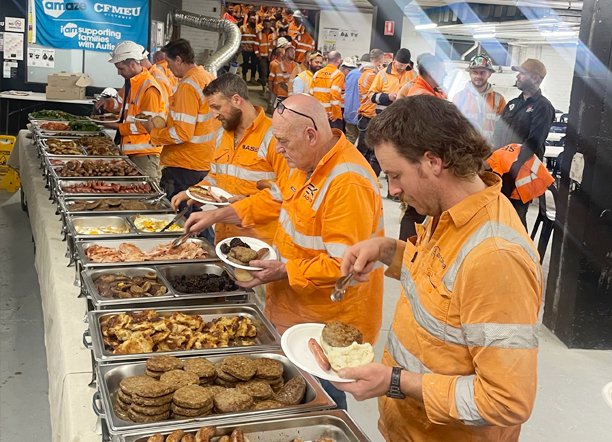
Ask to see their menu. If it's a laminated A4 with four options, keep looking. You want variety, rotation, and documented dietary labelling — especially on large milestone events where client and contractor guests are on site.
Replace with: diverse hot food spread, labelled trays, or meal service line
- Halal-certified options available daily
- Vegetarian and gluten-aware choices on rotation
- Allergen information clearly displayed at the point of service
- Menu rotates weekly — not monthly
They cover the full project lifecycle — not just the canteen
A strong site caterer isn't just running the daily canteen. They should be able to scale up for site BBQs, milestone celebrations, sod-turning events, and client meetings — without you having to source a second vendor.
The more a caterer understands your project timeline, the better they can anticipate demand spikes. Ask them whether they've catered milestone events for Tier 1 builders before. If they have, they know what's at stake when a developer client walks on site.
Replace with: site BBQ setup, milestone celebration, or contractor event catering
A caterer who refers you to a separate events company for anything beyond the daily canteen. Fragmentation creates coordination risk — and on a live site, that's the last thing you need.
References from builders — not restaurants
Any caterer can produce a glowing review from a birthday party. What you need are references from project managers, site supervisors, or procurement leads at builders you recognise. Ideally NSW-based, ideally Tier 1 or Tier 2.
Ask specifically: did they deliver reliably on large crews? Did they handle headcount changes without issue? Were there any food safety incidents? How did they respond when something went wrong?
A caterer with real construction credentials won't hesitate to put you in touch directly.
Vending and ancillary services — a genuine value-add
Between meal breaks, workers still need access to drinks, snacks, and basic essentials. A caterer that provides free vending machine installation removes a recurring friction point from your project and keeps spend on site rather than workers driving out for a servo run during break time.
It's a small thing that adds up — particularly on long-run projects where crew retention and morale directly affect productivity.
Replace with: free vending machine on site, or workers during break
Food safety and compliance — non-negotiable
NSW Food Authority registration, documented HACCP procedures, and staff with current food handler certifications aren't extras — they're baseline. On a construction site, a food safety incident doesn't just hurt workers; it can trigger a WorkSafe investigation and put your project on the front page for the wrong reasons.
Request documentation upfront. Any caterer worth working with will have it ready.
- NSW Food Authority registration current and on file
- HACCP plan documented and site-specific
- All staff food handler certified
- Public liability insurance documentation available on request
Servicing NSW construction sites since 2012
MyKitchen Café works with Tier 1 & Tier 2 builders across NSW
From daily canteens to milestone events — no cost, no hassle, no second vendor. Talk to us about your next project.
Or email admin@mykitchencafe.com.au